What happened
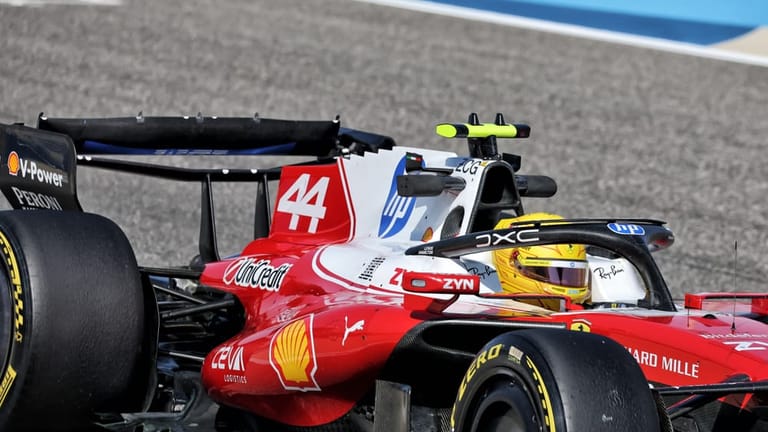
Lewis Hamilton ran five laps on Thursday morning in Bahrain with a rear wing unlike anything else on the grid. When he activated straight-line mode, the upper element didn't just open flat. It rotated 180 degrees and ended up completely upside down.
Sam Collins, Sky Sports' technical analyst, spotted it on the broadcast and initially thought it was a failure.
It wasn't. When Hamilton braked for Turn 1, the wing flipped back to its normal position.
Ferrari pulled the car in after those five laps and switched to the previous-spec wing for the rest of the day.
Video by: Maximum-Room-3999 / Reddit
Is it legal?
Yes. The FIA's technical director Nikolas Tombazis confirmed to The Race that the design complies with the regulations. The 2026 rules don't limit how far a rear wing can rotate. The only requirement is that the transition between positions happens within 0.4 seconds.
Tombazis added that the FIA has actively encouraged drag-reducing solutions under the new active aero framework.
Will it race?
That's unclear. Fred Vasseur called it a test item and wouldn't commit to a timeline. According to AutoRacer via ScuderiaFans, Ferrari tested several rotation angles at the factory and found the version that flips furthest produced the best results, but reliability isn't there yet.
What the analysts say
Gary Anderson ran his own simulation for The Race. He found the wing in corner mode produces a downforce-to-drag ratio of around 4:1. In straight-line mode with the flip, that drops to roughly 1:1, with a 75% reduction in rear downforce. His full breakdown compares the Ferrari approach to Alpine's collapsing wing and Audi's mid-pivot concept.
Mark Hughes, writing for Formula1.com, explains how the flip wing connects to the broader rear-end package Ferrari has been rolling out. The exhaust vane, the extended diffuser bodywork, and the repositioned differential all work as a system. His piece includes before-and-after comparison photos.
Jake Boxall-Legge at Autosport digs into the specific regulation articles that permit it, particularly the wing curvature rules under Article C3.11.1(e).How rivals reacted
Williams boss James Vowles told The Race the wing came as a surprise, though he noted there were packaging trade-offs. Red Bull and Mercedes were both reportedly taken aback by the telemetry data showing the impact on Ferrari's straight-line speed, according to AutoRacer via SportBible.
Vasseur was relaxed about the attention. "I'm sure that our competitors and everybody on the grid is doing exactly the same," he said. "It's true the last two things we brought on track were visible from outside, but it's not a big difference with the others."
Ferrari flip wing photos and technical comparison images
The Mark Hughes tech analysis for Formula1.com has the best still images available, including a side-by-side of the Ferrari rear end between week one and week two. It's also the clearest visual breakdown of how the exhaust vane and diffuser extension fit together.
The last time a wing trick caught everyone off guard
The closest precedent for what Ferrari did in Bahrain is probably McLaren's F-duct from 2010. Not in the specifics of how it worked, but in the way it arrived.
McLaren showed up to the opening race in Bahrain that year with a small air intake on top of the chassis that nobody could explain. It turned out to be the inlet for an internal duct system that ran through the cockpit and out to the rear wing.
When the driver covered a hole near the footwell with their knee, it redirected airflow to a slot in the wing, deliberately stalling it and cutting drag on the straights.
The FIA inspected it before the first race and cleared it. Red Bull's Christian Horner joked they called it "the f'ing duct."
Within months, nearly every team on the grid had their own version. Some required drivers to take a hand off the steering wheel to activate them.
It was banned for 2011 on safety and cost grounds, but the FIA clearly liked the underlying idea. DRS arrived the following year as the official, regulated version of what McLaren had invented through a loophole.
Autosport has a detailed retrospective on how the F-duct worked and evolved through the season, and PlanetF1 published a good explainer covering how each team adapted the concept differently.
The pattern is the same one playing out now: a team reads a regulation that everyone else took at face value, finds the rules don't actually say what everyone assumed, and builds something that leaves the paddock scrambling.
Whether Ferrari's version ends up in the same category depends on whether it works well enough to race. Five laps in testing is not a verdict.