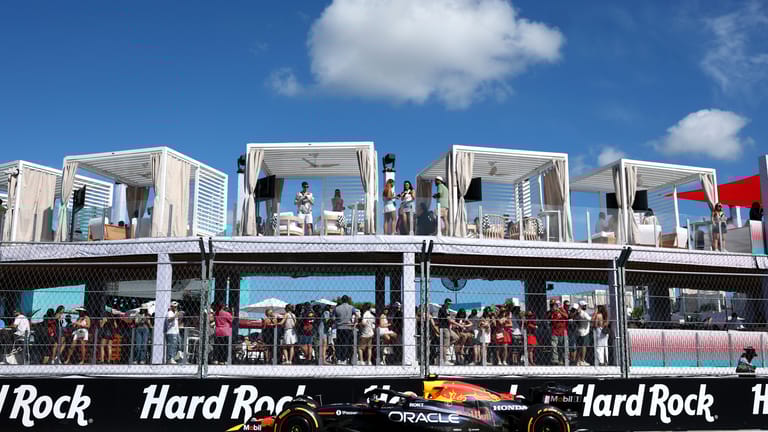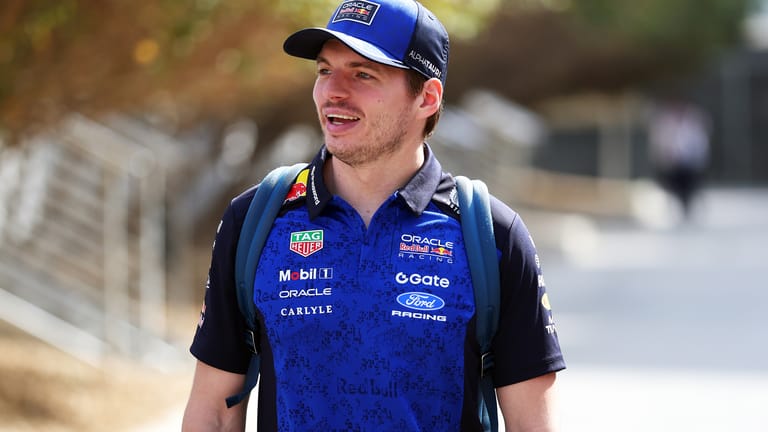
On Wednesday, Max Verstappen put on one of the most impressive individual displays in recent pre-season testing memory. 136 laps. Metronomic long-run consistency. An aggressive first-gear energy harvesting technique at Turn 10 that had rival engineers scrambling to understand what they were seeing. As we covered in our Day 1 report, Toto Wolff publicly anointed Red Bull as the benchmark of F1 2026 testing. The paddock consensus was clear: Verstappen had cracked this new formula faster than anyone.
On Thursday, he sat down in front of the assembled media in Bahrain and told them, in no uncertain terms, that he hates it.
"Formula E on steroids"
Verstappen's press conference on the second day of the opening Bahrain test was as blunt as anything I can remember from a frontrunner at this stage of a season. He described the 2026 cars as "not a lot of fun," labelled the energy management demands "anti-racing," and compared the entire driving experience to "Formula E on steroids."
For context, this isn't a driver lashing out after a difficult day. It's the man who dominated the previous day's running, whose team has seemingly adapted to the new power unit regulations better than anyone, and who spent his afternoon off watching Isack Hadjar complete 87 solid laps in the RB22 after a morning lost to a hydraulic leak.
Verstappen's frustration runs deeper than the usual testing grumbles. As Motorsport.com reported from the Dutch media session, he revealed that he'd actually told Red Bull last year he didn't want to continue testing the 2026 car in the simulator. The real-world experience, he said, matched what he'd felt in the sim: a car that demands you drive counter-intuitively, where braking longer or shifting to a different gear in a corner can matter more for your straight-line speed than the corner itself.
That's the core of his complaint. Under the new 50/50 power split between combustion and electrical energy, drivers are constantly managing battery charge. The fastest way through a corner isn't necessarily the best approach for overall lap time. You might gain two tenths carrying more speed through a turn but lose three tenths on the following straight because you recovered less energy. For someone like Verstappen, whose entire career has been defined by extracting every last fraction from a car on the limit, that feels fundamentally wrong.
And he wasn't shy about what it means for his future. His Red Bull contract runs through 2028, and he's been increasingly vocal about his growing interest in sportscar and GT racing.
"A winning car for me, that doesn't matter," he told reporters. "It needs to be fun to drive as well, at this stage of my career."
The paradox Red Bull can't ignore
Here's what makes this so fascinating, and slightly uncomfortable for everyone involved. Verstappen is the driver who appears best equipped to exploit these exact regulations.
That first-gear downshifting technique at Turn 10 we highlighted in our Day 1 coverage? By Thursday, rivals were already trying to copy it. As Autosport's Day 2 debrief detailed, Alex Albon said he'd explored the approach in Williams' simulator but found the real-world sensation of cornering in first gear far more unsettling than the virtual version. The technique squeezes maximum energy recovery from heavy braking zones, feeding the MGU-K to keep the battery topped up, and Red Bull designed their power unit with this kind of aggressive harvesting baked in from the start.
So the man who hates the game is currently the best at playing it. And he's telling you he might walk away anyway.
There's a reading of this where Verstappen is simply doing what he's always done: saying exactly what he thinks, consequences be damned. He acknowledged that his comments probably wouldn't be popular, but argued that he shouldn't be expected to pretend otherwise.
"I didn't write the regulation," he said. "If it was up to non-political aspects of making a regulation, I think the car would have probably looked very different."
Norris fires back
Lando Norris saw it differently.
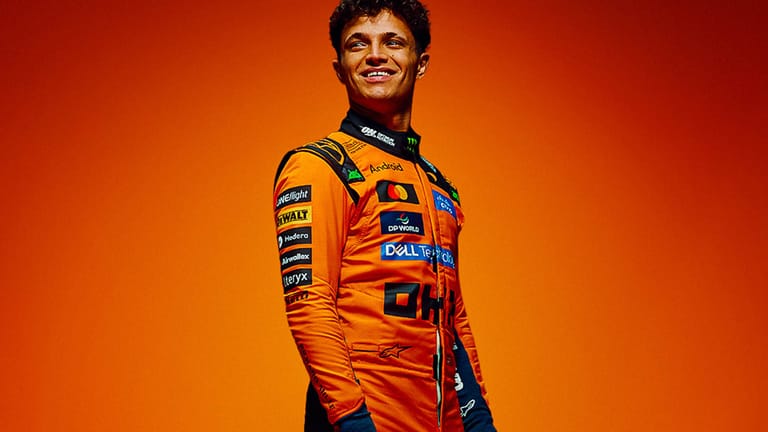
The reigning world champion, who topped the Day 1 timing sheets and completed 149 laps across Thursday's running alone (the highest single-day total of anyone in testing so far), offered a sharp counterpoint when Verstappen's comments were put to him.
"A lot of fun. I really enjoyed it," Norris said. "So yeah, if he wants to retire, he can retire."
It sounds spicy in a headline, but in the full context it wasn't combative. Norris acknowledged the cars feel very different to the previous generation and don't handle as nicely. He accepted they're slower and less refined. But his overall position was pragmatic: this is what the regulations are, the cars will improve dramatically over the coming months, and drivers earn enough money that complaining feels misplaced.
"We get paid a stupid amount of money to drive, so you can't really complain at the end of the day," Norris added. "Any driver can go and find something else to do. It's not like he has to be here."
He also made a sharp observation about perspective. If Verstappen had never driven a previous generation of F1 car and this was all he knew, Norris suggested, he'd probably think they were incredible. The dissatisfaction comes from comparison, not from any objective failing.
I don't see this as a rivalry flashpoint. These are two direct people giving honest answers from opposite ends of a philosophical spectrum. Verstappen values raw driving purity above all else. Norris values adaptability and pragmatism. Neither is wrong; they just weight things differently.
But the split does matter. If the sport's biggest names can't agree on whether the new cars are fun, it raises questions the FIA and Liberty Media need to take seriously. Hamilton called them "ridiculously complex" and "slower than GP2" on Day 1. Verstappen doubled down on Day 2. Norris stands virtually alone among the title contenders in offering a positive verdict.
Leclerc leads, Mercedes and Red Bull stumble
While the Verstappen-Norris exchange dominated the headlines, there was actual on-track action worth discussing.
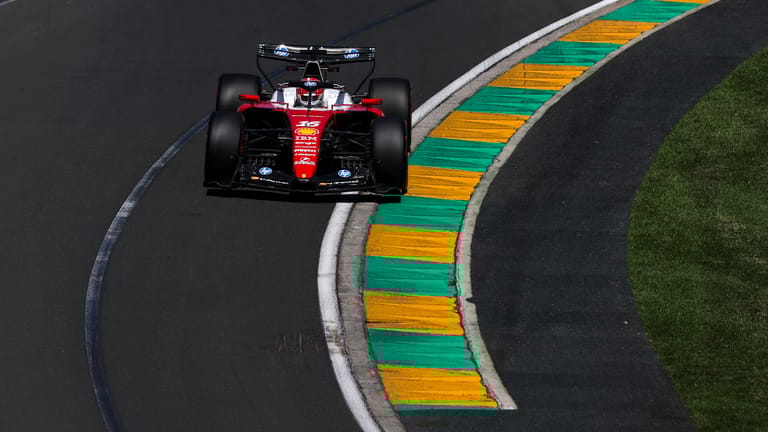
Charles Leclerc set the fastest time of the entire test so far, a 1:34.273 in the morning session that went unbeaten all day. Ferrari gave him the full day in the SF-26, and he made the most of it with 139 laps. The time was set on soft tyres in the hotter morning conditions, which makes it all the more impressive; nobody got close even when the track cooled in the evening.
Ferrari are emerging as a quiet story of this test. They haven't grabbed the same headlines as Red Bull or the same controversy as Mercedes, but the SF-26 looks composed, Leclerc looks comfortable, and 139 laps in a single day on brand-new machinery is a statement of reliability.
Both Mercedes and Red Bull lost significant chunks of running on Thursday.
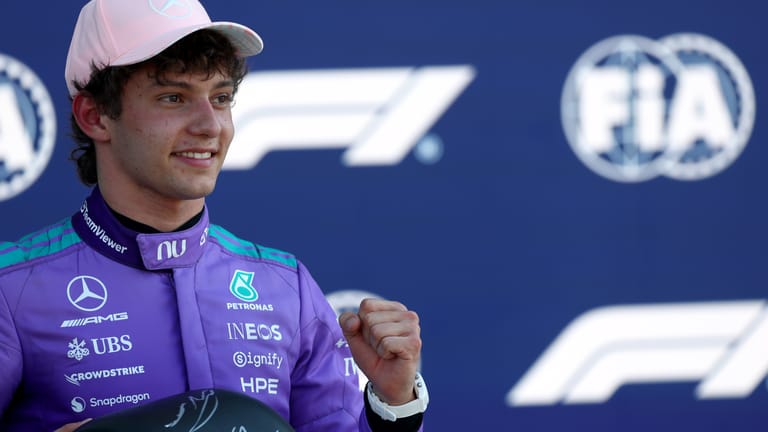
Mercedes had to perform a complete power unit change after Antonelli managed just three laps before a fault was detected. It was the second consecutive day of disrupted running for the young Italian, who had already lost time to a suspension issue on Wednesday.
Andrew Shovlin, Mercedes' trackside engineering chief, confirmed the team opted to swap the entire unit rather than the affected component because it was faster. George Russell salvaged the afternoon with 54 laps and the fourth-fastest time, but the cumulative picture for Mercedes in Bahrain is concerning: 57 laps on Thursday, 85 on Wednesday. Antonelli has just 33 total laps across two days.
Red Bull's morning was lost to a hydraulic leak discovered during the overnight car build. Hadjar spent the first few hours in his civvies on the hospitality terrace before the team got the RB22 ready just before the lunch break. He then completed a solid 87 laps in the afternoon and said the team's planned programme was largely unaffected. Impressive recovery, but it's still half a day's data gathering gone.
The rest of the grid
Oliver Bearman quietly had one of the best individual days in the field. The Haas driver completed 130 laps, set the third-fastest time at 1:35.394, and was constantly swapping positions with Russell throughout the afternoon. Haas are stacking up mileage efficiently, and Bearman is making a strong early case that the VF-26 is a capable package.
Aston Martin's woes deepened. Fernando Alonso took over from Stroll and managed 98 laps, but his best time was over four seconds off Leclerc's benchmark.
Stroll, speaking to media on Thursday, delivered the most brutally honest assessment of any driver this week: Aston Martin are "four seconds off the top teams, four and a half seconds." When asked for positives, his answer was devastating in its brevity: "The livery looks nice."
Multiple reports describe Alonso as visibly frustrated in the garage throughout the day. For a team that sold the Adrian Newey dream, this is a painful reality check.
There were three red flags in the afternoon. The first came when Valtteri Bottas lost part of his Cadillac's right-side mirror, which landed on track and narrowly missed Carlos Sainz's Williams. Pierre Gasly triggered the second when his Alpine stopped at Turn 1. A third was simply a procedural FIA systems check.
Williams continued their impressive reliability run with 131 laps split between Albon and Sainz. Racing Bulls managed 133 laps as Arvid Lindblad, the grid's sole rookie, put in 83 laps on his second day in the car. Audi completed 114 laps with a trouble-free day for both Hulkenberg and Bortoleto.
Cumulative lap count after two days
- Williams: 276
- Ferrari: 271
- McLaren: 261
- Haas: 245
- Red Bull: 223
- Cadillac: 216
- Audi: 210
- Racing Bulls: 208
- Mercedes: 142
- Aston Martin: 131
- Alpine: 125
Williams leading the cumulative mileage charts is a story in itself, considering they missed the Barcelona shakedown entirely. McLaren, Ferrari, and Haas are all in strong positions. Mercedes and Aston Martin, for very different reasons, are the two teams with the most ground to make up.
What Day 3 needs to answer
Friday is the final day of this first Bahrain test, and for some teams, it's approaching must-run territory.
Mercedes desperately need a clean day for Antonelli. The gap between his 33 laps and Russell's 110 is becoming a real problem, not just for data collection but for the rookie's confidence heading into a season that was always going to be challenging. Shovlin confirmed Russell will drive in the morning and Antonelli in the afternoon.
Red Bull will split duties between Verstappen and Hadjar. Whether Verstappen's press conference comments become a bigger talking point than whatever happens on track is an open question. The FIA and F1's commercial rights holders will have noted his words carefully.
And somewhere in the Aston Martin garage, Adrian Newey is looking at a car that's four seconds off the pace and wondering how much of it can be clawed back before Melbourne. The answer, almost certainly, is not enough.
Day 3 coverage from Bahrain coming Friday evening.